
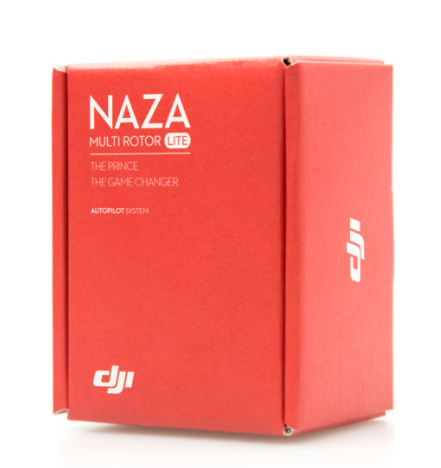
Description
DJI Naza-M Lite Flight Controller – Complete Guide for Multi-Rotor Enthusiasts
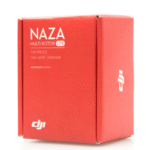
The DJI Naza-M Lite Flight Controller is one of the most popular entry-level flight controllers in the world of drones. Designed by DJI, a leader in drone technology, it is compact, cost-effective, and reliable. Despite being a simplified version of the advanced Naza-M series, it inherits stability, intelligent flight functions, and safety features that make it a favorite among beginner and intermediate drone pilots.
Whether you’re building your first quadcopter or upgrading a hexacopter, the DJI Naza-M Lite Flight Controller ensures stable performance, intelligent orientation control, and safe flying modes. This detailed guide explores its features, benefits, specifications, installation process, flight modes, and why it remains the top choice for hobbyists and professionals alike.
What is the DJI Naza-M Lite Flight Controller?
The DJI Naza-M Lite Flight Controller is an all-in-one autopilot system developed for multi-rotor aircraft. It integrates key sensors such as a 3-axis gyroscope, accelerometer, barometer, and compass into a compact design. This allows the system to measure altitude, orientation, and movement with high accuracy.
Its purpose is simple: to provide flight stability, self-leveling, and altitude hold, making drone flying less stressful and more enjoyable. Even new users can quickly learn to fly confidently using this system.
Why Choose the DJI Naza-M Lite Flight Controller?
Cost-Effective for Beginners
The DJI Naza-M Lite Flight Controller is affordable compared to other DJI controllers, making it the perfect entry point for drone enthusiasts.
Reliable Stability
Its advanced attitude stabilization algorithm ensures smooth flights, even in windy conditions.
Intelligent Flight Features
With multiple modes such as GPS Atti. Mode, Atti. Mode, and Manual Mode, pilots can switch between stable flying and full manual control.
Compatibility
It supports various multi-rotor configurations, from quadcopters to hexacopters, making it versatile for different drone builds.
Key Features of the DJI Naza-M Lite Flight Controller
All-in-One Compact Design
The controller integrates inner damping, sensors, and algorithms into one unit, saving space and reducing weight on drones.
Flight Mode Switching
Pilots can easily switch between GPS Atti. Mode (with GPS module), Atti. Mode, and Manual Mode depending on their flying needs.
Failsafe Mode
In case of signal loss, the drone automatically enters failsafe mode to ensure safety.
Intelligent Orientation Control (IOC)
The DJI Naza-M Lite Flight Controller includes Home Lock and Course Lock, which simplify navigation by fixing the drone’s forward direction relative to the home point.
Low Voltage Protection
Protects the battery by triggering safe landing or returning when power is too low.
Built-in Gimbal Stabilization
Supports camera stabilization for smoother aerial photography.
Technical Specifications of DJI Naza-M Lite Flight Controller
The DJI Naza-M Lite Flight Controller comes with powerful technical features:
- Input Voltage (MC): 4.8V ~ 5.5V
- VU Input: 7.2V ~ 26.0V (recommended 2S~6S LiPo)
- Power Consumption: Max 1.5W (0.3A @ 5V)
- Sensors: 3-axis gyroscope, accelerometer, compass, barometer, magnetometer
- Dimensions:
- GPS & Compass: 46 x 9 mm (Dia x W)
- MC: 45.5 x 31.5 x 18.5 mm
- VU: 32.2 x 21.1 x 7.7 mm
- Weight: MC: 25g, VU: 20g
- Supported Multi-Rotor Configurations: Quad (I4, X4), Hexa (I6, X6, IY6, Y6)
- ESC Output Frequency: 400Hz refresh
- Operating Temperature: -10°C to 50°C
How Does the DJI Naza-M Lite Flight Controller Work?
The DJI Naza-M Lite Flight Controller functions as the “brain” of a multi-rotor. It processes signals from the transmitter and combines them with data from onboard sensors to adjust motor speed, stabilize the drone, and maintain flight control.
Flight Modes Explained
- GPS Atti. Mode (with GPS module): Provides position hold, altitude hold, and navigation stability.
- Atti. Mode: Maintains altitude and stability but without GPS positioning.
- Manual Mode: Allows full pilot control with no assistance.
Failsafe Function
If the signal between transmitter and receiver is lost, the controller triggers failsafe mode. Depending on configuration, the drone either lands safely or returns to home (with GPS).
Intelligent Orientation Control (IOC)
IOC changes how the drone interprets control stick inputs. For example, in Home Lock, pulling the stick back always brings the drone toward the pilot, regardless of its orientation.
Advantages of Using the DJI Naza-M Lite Flight Controller
Easy to Install
The all-in-one design makes setup straightforward, even for beginners.
Smooth Flying Experience
Thanks to stabilization algorithms, even new users can achieve steady flights.
Versatile Compatibility
Works with multiple configurations, from small quadcopters to larger hexacopters.
Safety Features
Failsafe, low voltage protection, and motor disarm functions ensure safe operation.
Professional Features for Hobbyists
Although budget-friendly, it includes advanced functions like gimbal stabilization and remote adjustment.
Installing the DJI Naza-M Lite Flight Controller
Step 1: Mounting
Mount the main controller (MC) in the center of the drone’s frame to reduce vibration.
Step 2: Connecting Components
- Connect ESCs to the controller.
- Attach the LED module for system status.
- Connect the power module and receiver.
Step 3: Software Setup
Use the DJI Assistant software (compatible with Windows XP, 7, 8) to configure flight modes and calibrate sensors.
Step 4: Calibrating Sensors
Calibrate the compass, accelerometer, and gyroscope for accurate flight performance.
Flight Performance with DJI Naza-M Lite Flight Controller
- Hovering Accuracy in GPS Mode:
- Vertical: ±0.8m
- Horizontal: ±2.5m
- Max Tilt Angle: 45°
- Max Yaw Angular Velocity: 200°/s
- Ascent/Descent Speed: ±6m/s
These performance stats ensure stable hovering, smooth directional changes, and responsive controls.
Who Should Use the DJI Naza-M Lite Flight Controller?
The DJI Naza-M Lite Flight Controller is designed with accessibility, reliability, and versatility in mind. While it may be a simplified version of advanced DJI controllers, it still offers professional-grade stability and essential safety features, making it suitable for a wide range of users. Below are the groups who will benefit the most from this system.
Beginner Drone Pilots Learning Stability and Control
For newcomers to the world of drones, flight stability and safety are the top priorities. The DJI Naza-M Lite Flight Controller offers:
- Self-leveling and altitude hold features that minimize the chances of crashes caused by inexperience.
- Failsafe and low-voltage protection, ensuring that even mistakes won’t always lead to a total loss of the aircraft.
- A straightforward setup process, with simplified calibration compared to more advanced controllers.
This makes it a perfect entry point for anyone learning to fly drones for the first time. Instead of struggling with complicated controls, beginners can focus on developing their flying skills while relying on the Naza-M Lite’s stabilization algorithms.
Hobbyists Building DIY Quadcopters or Hexacopters
Drone building is a popular aspect of the hobby, and enthusiasts often experiment with different frame types and rotor configurations. The DJI Naza-M Lite Flight Controller supports multiple setups, including:
- Quadcopters (I4, X4)
- Hexacopters (I6, X6, IY6, Y6)
This flexibility allows DIY builders to test and customize their creations without investing in high-end controllers. Additionally, the compact all-in-one design saves space on the frame and reduces wiring complexity, which is especially valuable when experimenting with new builds.
Enthusiasts Looking for a Cost-Effective Yet Reliable Flight System
Not every drone pilot wants to invest in expensive, professional-grade equipment. Many enthusiasts seek a controller that offers reliable performance at a reasonable cost — and this is exactly where the DJI Naza-M Lite Flight Controller shines.
- It delivers stability and intelligent control at a fraction of the cost of advanced systems like the DJI Naza-M V2 or A3.
- Its built-in safety and intelligent flight modes provide peace of mind without breaking the bank.
- The lightweight design reduces overall payload, contributing to longer flight times.
This makes it a perfect choice for pilots who value performance but are mindful of budget.
Aerial Photographers Who Need Stable Footage with Gimbal Support
Smooth and stable aerial footage requires not just good piloting skills but also a reliable flight controller. The DJI Naza-M Lite Flight Controller is equipped with a built-in gimbal stabilization function, ensuring that mounted cameras remain steady even when the drone encounters wind or sudden movements.
- GPS Atti. Mode ensures position hold and stable hovering, perfect for capturing still shots or smooth panning.
- Altitude hold and self-leveling reduce shaky footage caused by sudden drops or tilts.
- The motor arm/disarm feature provides safe handling when attaching or detaching camera equipment.
For photographers or videographers entering aerial cinematography, the Naza-M Lite provides a dependable, budget-friendly foundation for professional-looking results.
✅ In summary:
The DJI Naza-M Lite Flight Controller is best suited for beginners, DIY hobbyists, cost-conscious enthusiasts, and entry-level aerial photographers. It bridges the gap between simplicity and advanced functionality, making drone flying both safe and enjoyable.
Comparison with Other DJI Flight Controllers
When choosing a flight controller, it’s important to understand not only what yours can do, but what it doesn’t do compared to other models. Below are in-depth comparisons of the DJI Naza-M Lite Flight Controller vs two more advanced DJI systems: the Naza-M V2 and the DJI A3.
Naza-M Lite vs Naza-M V2
| Feature | DJI Naza-M Lite Flight Controller | DJI Naza-M V2 Flight Controller |
|---|---|---|
| Target User | Beginners / hobbyists who want a stable, reliable system without the complexity or cost of professional features. | Intermediate to advanced users who require more precise GPS and navigation features, including prospects of semi-autonomous flight. |
| GPS & Waypoint Functionality | Lite supports GPS Atti Mode (position hold, hover, etc.), but does not support advanced features like waypoints, geo-fencing, or return on demand via waypoints. | V2 supports full GPS functionality: waypoints, return-to-home using GPS data, more advanced flight paths, better GPS accuracy, ability to map routes. |
| Feature Complexity | Simplified: fewer settings and fewer parameters to adjust, easier calibration and less potential for error. Less hardware to set up and less tuning needed. | More complex: more parameters, more sensors, more calibration, more hardware compatibility (e.g. more GPS antenna options, possible external modules). |
| Cost | Lower cost, more accessible for hobbyists. | Higher cost due to added hardware, more sensors and features. More expensive to buy and potentially more expensive to maintain. |
| Performance in Challenging Conditions | Solid stabilization and attitude control; in mild to moderate wind and normal conditions performs very well. But GPS precision, loss of signal recovery, and response in complex flight planning are more limited. | Better handling in difficult conditions: improved GPS lock, better path planning and waypoints allow safer flights in environments where pre-planned routes or safe emergency return are needed. |
| Use Cases | Casual aerial photography, small quadcopters/heavy lifts without complex navigation, learning flights. | Commercial or professional use where flight planning, recurring missions, mapping, inspection, or more demanding flight patterns are required. |
Summary:
- The DJI Naza-M Lite Flight Controller is budget-friendly, simpler to use, less hardware overhead, ideal for those whose priority is stable flight, basic GPS hover and attitude stabilization without needing advanced navigation.
- The Naza-M V2 adds more GPS features, waypoint planning, more precise control and flexibility, suited for more serious hobbyists or pros who want autonomous flight paths.
Naza-M Lite vs A3 Controller
| Feature | DJI Naza-M Lite Flight Controller | DJI A3 Controller |
|---|---|---|
| System Redundancy | Single controller, standard sensors (gyro, accelerometer, barometer, compass). If one sensor fails, there is no built-in backup. | Triple redundancy: multiple redundant IMUs (Inertial Measurement Units), redundant sensors, power redundancy. Designed to maintain safe flight even if one component fails. |
| Safety & Reliability | Good safety features (failsafe, arm/disarm, low voltage protection) that are sufficient for hobbyist usage. But less redundancy in both sensors and power. | Very high reliability. Professional level safety: backup IMUs, dual IMUs, redundant power supply. If one sensor or IMU fails, the system can fall back to another. This is critical in commercial or industrial operations where failure could be costly or dangerous. |
| Cost & Complexity | Much lower cost, fewer components to install, configure, maintain. Easier to learn, lower risk if something goes wrong. | High cost: hardware cost, installation, calibration, maintenance; more complexity in setting up redundancies, tuning multiple IMUs, ensuring failover works correctly, possibly higher regulatory requirements. |
| Flight Envelope and Performance | Supports tilt angles up to ~45°, good yaw rates, solid under typical loads. For moderate sized quads or hexas, limited by sensor precision as conditions become more extreme. | Higher tolerance for heavier payloads, more aggressive flight profiles (faster ascent/descent, larger tilt, more precise control), better control under load or in tougher environmental conditions. Also better GPS systems, more refined control loops, etc. |
| Intended Use / Applications | Hobbyists, DIY drone builders, aerial photography/videography where mission complexity is lower. | Professional use cases: mapping, film production, inspections, industrial monitoring, projects where safety and redundancy are critical (e.g. over people or property). Possibly used for regulatory compliance in some jurisdictions. |
Summary:
- The DJI Naza-M Lite Flight Controller is not designed for mission-critical or heavy-duty applications. It shines in cost efficiency, simplicity, and giving beginners a stable platform.
- The A3 Controller is built for serious/dependable operations: redundancy, higher performance, more sensors, better safety margins. If your projects require liability, precision, or sustained reliability, A3 is the better investment.
Overall Pros & Cons: DJI Naza-M Lite vs Others
Here’s a side-by-side quick pros & cons of Naza-M Lite in comparison with V2 and A3:
| Pros of DJI Naza-M Lite | Cons / Limitations |
|---|---|
| Low entry cost | Lacks advanced GPS route planning / waypoint missions |
| Simpler setup and calibration | Less redundancy in sensors and power — more risk in failure modes vs A3 |
| Lightweight & compact, lower weight burden | Less precise GPS performance compared to higher end models |
| Good stability, safety basic features, motor arm/disarm, failsafe, etc. | Not intended for heavy payloads or commercial regulatory demands |
| Great for beginners to learn with confidence | Less flexibility for scaling up mission complexity or automation |
Which One Should You Choose?
To decide between DJI Naza-M Lite Flight Controller, Naza-M V2, or A3, ask yourself:
- What is the primary use?
- Learning, photography, casual flights → Lite.
- Mapping, route/mission flying, advanced hobby use → V2.
- Commercial, inspection, over people, regulatory compliance, high reliability → A3.
- What is your budget?
- Lite is significantly lower cost.
- V2 is mid-level.
- A3 is premium.
- What level of risk and safety is acceptable?
- Lite gives basic safety features; failures of sensors or GPS will more likely result in loss rather than graceful fallback.
- V2 adds more GPS functionality; A3 adds redundancy.
- Scalability and future-proofing
- If you think you will later want waypoint missions or heavy aircraft, investing more now (e.g. in V2 or A3) could save headaches later.
- If you’re okay with the basics, Lite may be all you need.
Conclusion
- The DJI Naza-M Lite Flight Controller strikes a strong balance for hobbyists and beginners: providing essential stabilization, safety, and decent GPS-assisted flight without the complexity or cost of higher end systems.
- The Naza-M V2 expands upon what Lite offers — better GPS support, more flight autonomy, more detailed control — at a higher cost and with more setup.
- The A3 Controller is in a different category: professional, redundant, built for reliability and intense usage.
If your operations are simple, you’re working with lighter builds, or you’re just getting into UAV / multi-rotor flying, the DJI Naza-M Lite Flight Controller may well be the optimal choice. If later you find you need advanced route planning, heavier payloads, or redundant safety, that’s when you could consider upgrading to Naza-M V2 or A3.
Package Contents of DJI Naza-M Lite Flight Controller
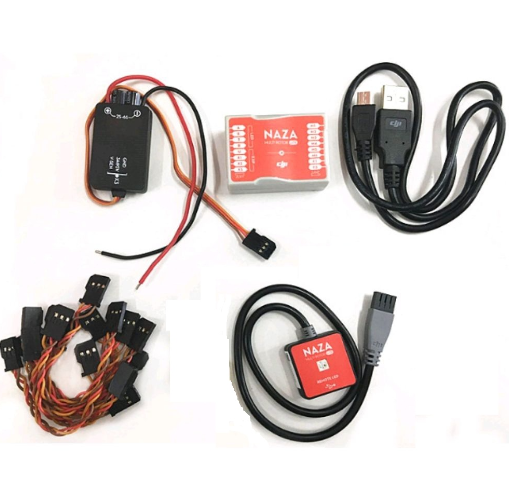
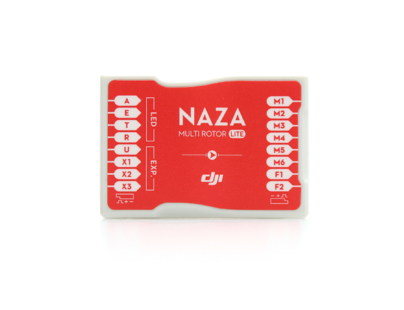
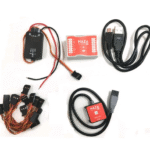
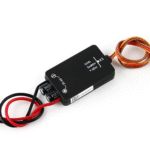
- 1 x DJI Naza Controller Unit
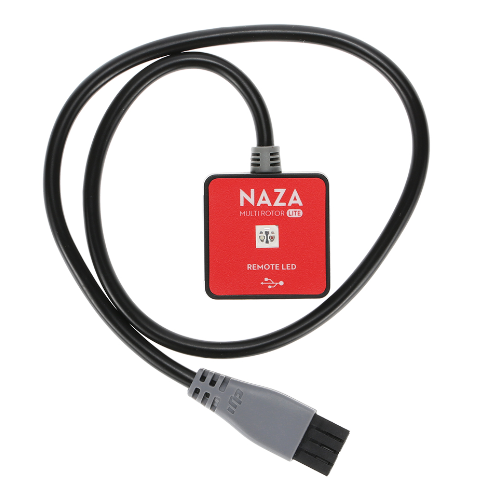
- 1 x DJI Remote LED Module
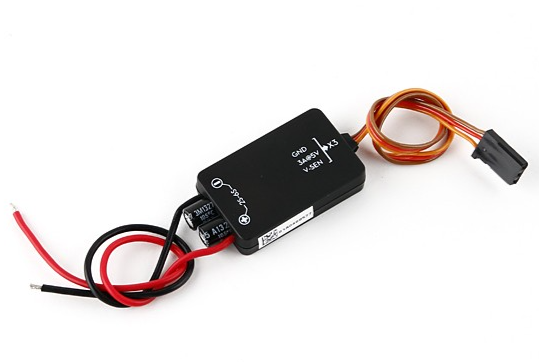
- 1 x DJI Power Module
- 1 x USB to MicroUSB Cable (18 inches)
- 8 x Servo Cables (5 inches each)
Safety Features in DJI Naza-M Lite Flight Controller
One of the most important aspects of any drone system is safety. DJI has equipped the Naza-M Lite Flight Controller with multiple built-in safety functions that protect both the aircraft and the pilot. These features not only extend the lifespan of your drone but also help prevent accidents during unexpected situations.
Low Voltage Protection
Lithium Polymer (LiPo) batteries are widely used in drones due to their high energy density and lightweight design. However, they are also sensitive to over-discharge. If a LiPo battery is drained below its minimum voltage, it can lead to permanent cell damage, reduced capacity, or even swelling and fire hazards.
The DJI Naza-M Lite Flight Controller comes with two levels of low voltage protection:
- Level 1 Warning (Early Alert): When the system detects that the battery voltage is approaching a low threshold, it gives the pilot a warning through LED indicators or transmitter alerts. This gives enough time to prepare for a safe landing.
- Level 2 Protection (Automatic Action): If the battery voltage continues to drop, the system automatically triggers safety actions such as descending slowly or initiating a failsafe landing to prevent complete power loss mid-flight.
This dual protection ensures that the drone never suddenly loses power in the air, greatly reducing the risk of crashes.
Failsafe Mode
Losing connection between the drone and the transmitter is one of the most common risks in RC flying. Causes can include interference, signal obstruction, or the transmitter going out of range. Without failsafe, a drone would simply drop out of the sky or fly uncontrollably, creating dangerous situations.
The failsafe feature of the DJI Naza-M Lite Flight Controller prevents this problem by automatically activating pre-set safety actions when it detects signal loss:
- In GPS Atti. Mode (with GPS module attached): The drone can return to its recorded “home point” using GPS guidance, and then land safely.
- In Atti. Mode (without GPS): The drone will automatically descend in a controlled manner to the ground.
This intelligent failsafe response not only protects your drone from getting lost but also minimizes damage to property and people.
Motor Arm/Disarm Function
Accidental motor spin-up is one of the biggest risks when working with drones, especially during setup, calibration, or transportation. Even a small propeller can cause serious injury if it starts spinning unexpectedly.
The DJI Naza-M Lite Flight Controller includes a motor arm and disarm function that requires a specific stick combination on the transmitter to power the motors. This means the motors will never start running unless the pilot deliberately arms them.
- Motor Arm: The motors only activate when the correct stick input is given, ensuring intentional takeoff.
- Motor Disarm: After landing, the same stick command shuts off the motors instantly, preventing accidental throttle bumps from spinning the props.
This feature adds a crucial safety layer, especially for beginners who may not yet have complete control over their transmitter inputs.
Software Support for DJI Naza-M Lite Flight Controller
The DJI Assistant Software allows configuration, firmware updates, and fine-tuning. Compatible with Windows XP, Windows 7, and Windows 8, it provides real-time adjustments for smooth performance.
Final Verdict: Why Choose DJI Naza-M Lite Flight Controller?
The DJI Naza-M Lite Flight Controller is the perfect balance of affordability, reliability, and intelligent features. It makes flying multi-rotor drones safe, simple, and fun. From GPS-based stability to failsafe protection, it offers everything beginners and hobbyists need.
If you’re searching for a cost-effective and feature-rich autopilot system, the DJI Naza-M Lite Flight Controller is an excellent choice for your next build.
Link
 In stock now. Limited quantities available. Ships within 24 hours.
LOOKING FOR MORE? DISCOVER EVERYTHING WITH OFFER AT http://www.loftyagrotech.com
Explore more in our camera drone collection and find the right aerial companion.
Before flying, ensure you’re compliant with India’s drone regulations (DGCA DigitalSky Portal).

Reviews
There are no reviews yet.