
Recognised & Supported by
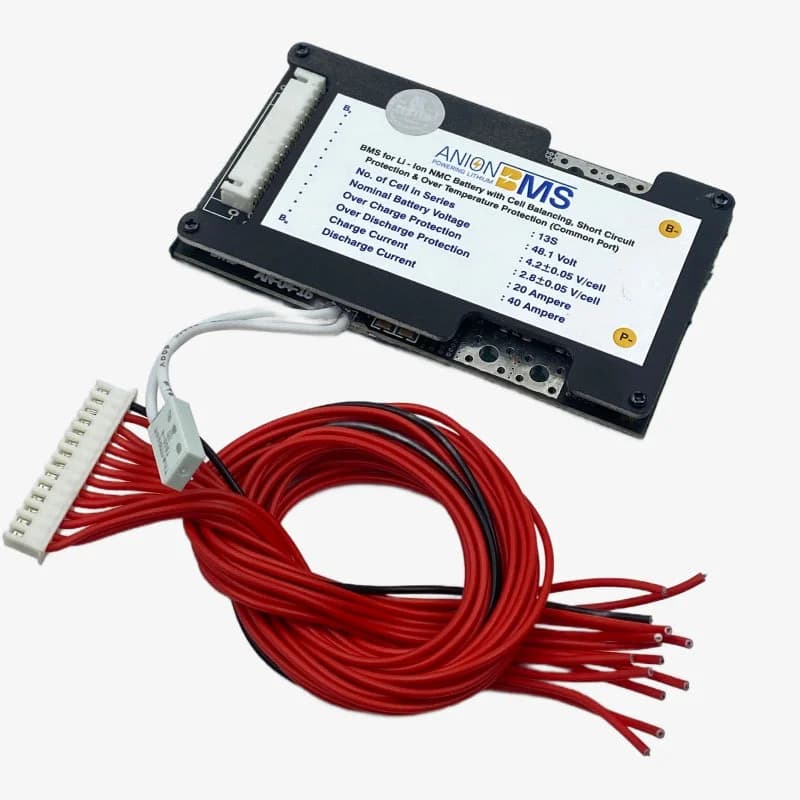
A BMS or protection board is any electronic control circuit that monitors, manages, and regulates the charging and discharging of any rechargeable battery (cell or combination of cell called battery). The lithium-ion batteries can be used only in specified conditions called safe operating area, and therefore BMS is necessary in order to monitor battery state, ensure safety of operation, long battery life. The battery characteristics to be monitored includes its state of charge, safe operating area, voltage, current, temperature, individual cell voltage, battery capacity and many more. The main task of battery management systems is to ensure the optimal use of the residual energy present in a battery. In order to avoid loading of batteries, BMS protects the battery from:
This BMS offers below mentioned protection of utmost importance.
This protection board is widely used in all kinds of 18650 Li-ion battery packs and offers multi-scenario application.
1 set of 13S 48V 40A BMS for Lithium Ion NMC Battery
| Charge Voltage (V) | 4.2 * N |
|---|---|
| Charge Current Threshold (A) | 20 |
| Discharge Current Threshold (A) | 40 |
| Pulsed Discharge Current (A) (5 Sec) | 200 |
| Overcharge Detection Voltage per Cell (V) | 4.2 ± 0.05 |
| Overcharge Release Voltage Per Cell (V) | 4.15 ± 0.05 |
| Over-discharge Detection Voltage (V) | 2.80 ± 0.05 |
| Over-discharge Release Voltage (V) | 3.00 ± 0.05 |
| Overcharge Voltage Protection Delay Time (ms) | 600 - 1400 |
| Over discharge Voltage Protection Delay Time (ms) | 200 - 600 |
| Overcharge Current Protection Delay Time (ms) | 100 - 600 |
| Temperature Protection (Load Cut Off) ( °C) | 70 |
| Working Temperature Range ( °C) | -65 to 65 |
| Storage Temperature Range ( °C) | 20 - 40 |
| Sleep Current (when Over Discharged) (µA) | <100 |
| Cell Balancing Function | Yes |
| Cell Balancing Method | Passive |
| Bleed Start Point / Cell Balance Voltage (V) | 4.100 ± 0.05 |
| Bleed Current / Balance Current (mA) | 40 - 40 |
| Load Short Circuit Protection | Yes Load Cut Off |
For official government agricultural guidelines, scheme updates, and research initiatives, please visit the National Agriculture Portal. Click here →


