
Recognised & Supported by
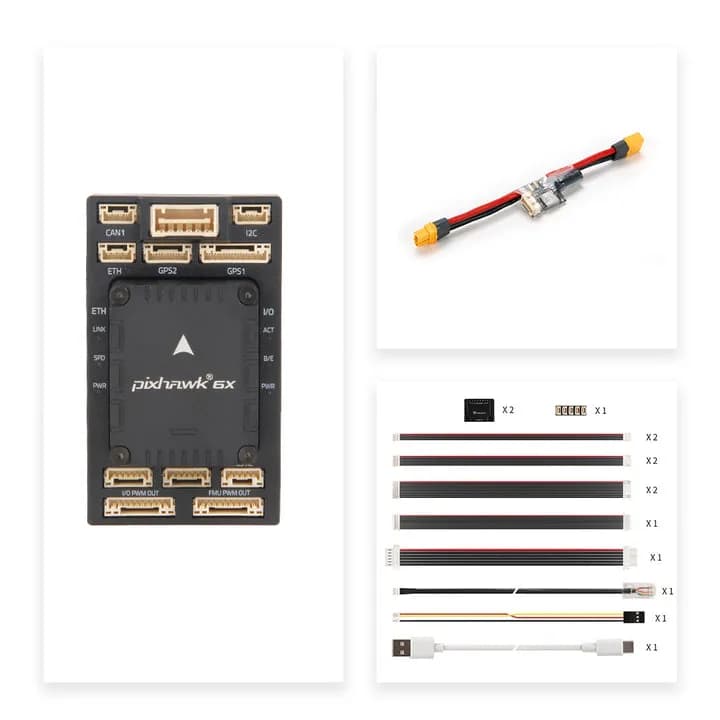
The Holybro Pixhawk 6X Flight Controller is an advanced modular autopilot solution designed for reliable UAV performance, precision navigation and demanding drone applications.
Triple Sensor Redundancy: Three IMU sensors and dual barometers support dependable flight measurements.
Powerful Processing: STM32H753 processor delivers up to 480 MHz processing performance.
Advanced Sensor Technology: ICM-45686 sensors with BalancedGyro technology enhance measurement stability.
Modular Architecture: Separate IMU, FMU and baseboard design simplifies system integration.
Improved Vibration Isolation: Advanced isolation material helps minimize vibration-related sensor interference.
High-Speed Connectivity: Ethernet interface supports mission computer integration.
Complete Set: Includes Standard Baseboard V2, PM02D HV Power Module and cable set.
The Holybro Pixhawk 6X Flight Controller is an advanced modular autopilot platform engineered for professional UAV development, autonomous flight systems and high-performance drone applications. Combining powerful processing capabilities, redundant sensor architecture and flexible hardware integration, this flight control system provides a dependable foundation for sophisticated aerial platforms.
Designed by Holybro, this controller integrates a high-performance STM32H753 processor, three inertial measurement units (IMUs), dual barometer sensors and advanced vibration isolation technology. Its modular architecture separates the flight management unit (FMU), inertial measurement unit (IMU) and baseboard, providing flexibility for different UAV configurations.
The Standard Baseboard V2 combination provides the essential hardware required for integrating the controller into compatible drone systems. The package includes the autopilot module, standard baseboard, PM02D HV power module and cable set.
With support for PX4 and ArduPilot firmware, this platform is suitable for developers, UAV manufacturers, research institutions and professionals building autonomous aerial systems.
The Holybro Pixhawk 6X Flight Controller architecture focuses on processing performance, sensor redundancy, electrical isolation and modular hardware integration.
At its core is the STM32H753 microcontroller, featuring a 32-bit Arm Cortex-M7 processor operating at up to 480 MHz. With 2 MB of flash memory and 1 MB of RAM, the FMU provides processing resources for flight control algorithms, sensor data processing and communication management.
A separate STM32F103 processor manages input/output operations. This architecture separates important flight management and I/O functions, supporting organized control-system operation.
The modular hardware arrangement consists of three primary sections:
IMU Module: Handles inertial measurements through integrated accelerometer and gyroscope sensors.
FMU: Executes flight management, navigation and control-related processing.
Baseboard: Provides electrical interfaces and connectivity for external flight-system components.
The modules communicate through dedicated 100-pin and 50-pin Pixhawk Autopilot Bus connectors.
This design provides a flexible hardware foundation for UAV developers who require configurable flight-control electronics.
The current Rev. 8 hardware incorporates three ICM-45686 accelerometer and gyroscope sensors with BalancedGyro technology.
These sensors provide inertial measurements required for flight stabilization, movement detection and attitude estimation.
The redundant sensor arrangement allows the flight-control architecture to work with multiple measurement sources rather than relying on a single IMU.
Three independent IMU sensors provide additional measurement redundancy.
This architecture supports improved reliability in applications where consistent inertial measurements are important for flight-control performance.
The integrated ICP20100 and BMP388 barometers provide two independent pressure-sensing sources.
Barometric measurements are commonly used in UAV systems for altitude estimation and vertical flight-control functions.
The controller incorporates specially developed vibration isolation material designed to reduce unwanted mechanical vibration reaching the sensitive IMU components.
The isolation system uses a higher-spectrum resonance frequency compared with traditional foam-based approaches.
This helps improve the quality of inertial measurements in applications involving motor, propeller and airframe vibration.
The integrated temperature-control arrangement helps maintain the IMU sensors within an appropriate operating temperature range.
This feature supports more consistent sensor performance under changing environmental conditions.
A flight controller operates as the central electronic processing unit of an unmanned aerial vehicle.
During operation, onboard sensors continuously collect information about the aircraft's movement, orientation and altitude.
The flight-control system processes this information and executes control algorithms to determine the appropriate flight response.
The general operating sequence includes:
Sensor Data Collection: IMU sensors measure acceleration and angular velocity across the aircraft's movement axes.
Altitude Measurement: Barometers provide atmospheric pressure measurements used for altitude-related calculations.
Sensor Processing: The flight management processor receives and processes sensor information.
Flight Estimation: The autopilot software estimates the aircraft's attitude and movement.
Control Computation: Flight-control algorithms calculate the required control responses.
Output Generation: Appropriate control signals are sent to connected ESCs, servos and other compatible peripherals.
Continuous Feedback: Sensor measurements are repeatedly updated to support ongoing flight stabilization.
The actual flight behaviour depends on firmware configuration, vehicle parameters, sensor calibration and the connected hardware.
High-Performance Processing: STM32H753 processor with up to 480 MHz clock speed.
Triple IMU Redundancy: Three integrated accelerometer and gyroscope sensors.
BalancedGyro Technology: Advanced inertial sensing using ICM-45686 sensors.
Dual Barometers: ICP20100 and BMP388 pressure sensors.
Modular Construction: Independent IMU, FMU and baseboard architecture.
Dedicated Bus Connections: 100-pin and 50-pin Pixhawk Autopilot Bus interfaces.
Isolated Sensor Domains: Separate sensor buses and power-control arrangements.
Advanced Vibration Damping: Specially developed vibration isolation material.
Ethernet Connectivity: Supports high-speed mission computer integration.
Temperature-Controlled Sensors: Integrated IMU temperature management.
Firmware Flexibility: Compatible firmware options include PX4 and ArduPilot, subject to hardware revision and firmware version.
Complete Hardware Set: Includes standard baseboard, PM02D HV power module and cable set.
The redundant sensor architecture provides additional measurement sources for flight-control operations.
The high-speed processor provides computing resources for complex flight-management tasks and autonomous UAV development.
The modular arrangement allows developers to work with different compatible baseboards and external components.
The advanced isolation design helps reduce unwanted vibration interference in sensitive inertial measurements.
Firmware compatibility and hardware connectivity make the platform suitable for research, prototyping and commercial UAV development.
The combination of processing power, sensor redundancy and communication interfaces makes this hardware suitable for advanced drone engineering projects.
Parameter | Technical Details |
|---|---|
Main Processor | STM32H753 |
Processor Speed | 480 MHz |
Processor Architecture | Arm Cortex-M7, 32-bit |
Flash Memory | 2 MB |
RAM | 1 MB |
IO Processor | STM32F103 |
IMU Configuration | Triple IMU |
Current IMU Sensors | 3 × ICM-45686 |
Barometers | ICP20100 + BMP388 |
Magnetometer | BMM150 |
Communication | Ethernet |
Module Connection | 100-pin + 50-pin |
Power Module | PM02D HV |
Baseboard | Standard Baseboard V2 |
This autopilot hardware is suitable for a variety of UAV development and autonomous aerial applications.
Agricultural drone development
Autonomous multirotor systems
Industrial inspection drones
Aerial mapping and surveying platforms
Research and development UAVs
Drone navigation and stabilization projects
Fixed-wing UAV development
VTOL aircraft development
Autonomous robotics research
Professional drone prototyping
Experimental flight-control systems
Mission computer-integrated UAV platforms
Agriculture and Precision Farming
Supports the development of agricultural UAV platforms used for crop monitoring, aerial surveying and precision agriculture applications.
Aerospace and Aviation
Suitable for UAV engineering, flight-control research and autonomous aircraft development.
Industrial Automation
Can be integrated into compatible aerial platforms for industrial inspection and monitoring projects.
Research and Education
Provides a hardware platform for universities, engineering colleges, laboratories and technical research institutions.
Drone Manufacturing
Suitable for UAV manufacturers developing customized multirotor, fixed-wing and VTOL systems.
Robotics and Autonomous Systems
Supports experimental development involving autonomous navigation, sensor integration and mission-based control systems.
This hardware is intended for integration into compatible UAV electronics architectures.
PX4 Autopilot
ArduPilot
Firmware support depends on the specific hardware revision and software release. Verify the supported version before installation.
Compatible system components may include:
Brushless electronic speed controllers (ESCs)
Compatible GPS and GNSS modules
Telemetry communication modules
RC receivers
Compatible power modules
Mission computers
External navigation sensors
Compatible servos and PWM-controlled devices
The Standard Baseboard V2 provides the interface connections required for system integration. However, external components must meet the electrical, connector and firmware requirements of the selected configuration.
Always verify port assignments, voltage requirements and supported peripherals before connecting additional hardware.
Correct installation is important for achieving reliable flight-control performance.
Check the flight controller, standard baseboard, PM02D HV power module and cable set for physical damage or missing components.
Install the flight controller assembly securely inside the UAV frame using suitable mounting hardware.
Ensure that the orientation matches the flight-controller configuration.
Ensure that the controller module is correctly connected to the Standard Baseboard V2 through the designated Pixhawk Autopilot Bus interfaces.
Integrate the supplied PM02D HV power module according to the manufacturer's wiring instructions.
Verify polarity and electrical compatibility before applying power.
Connect compatible GPS, telemetry, RC receiver, ESC and other required peripherals using the appropriate ports.
Install or configure the supported PX4 or ArduPilot firmware version for the exact hardware revision.
Perform the required sensor calibration, orientation verification, radio setup and actuator testing before flight.
The system operates as the primary flight-management hardware in a compatible UAV.
Once powered and correctly configured, it receives sensor information and processes flight-control instructions.
Typical operating functions include:
Inertial measurement processing
Aircraft attitude estimation
Altitude-related sensing
Flight stabilization
Motor and servo output control
External communication
Mission computer integration
Autonomous flight-control operations
The available operating modes and functions depend on the installed firmware, connected peripherals and vehicle configuration.
Before the first flight, complete all mandatory calibration and pre-flight checks.
Regular inspection helps maintain consistent hardware performance.
Recommended maintenance practices include:
Inspect connectors and cables for damage.
Check the mounting arrangement for looseness.
Keep the controller free from dust, moisture and conductive debris.
Inspect the vibration isolation material periodically.
Check the power module and wiring connections.
Verify firmware compatibility before performing updates.
Recalibrate sensors when required.
Check sensor readings before flight operations.
Store the equipment in a suitable protective environment.
Avoid unnecessary disassembly of the flight-controller module.
Proper electrical and mechanical handling is essential when installing and operating this autopilot system.
Never exceed the specified electrical input ratings.
Verify power polarity before connecting the power module.
Avoid short circuits across connector pins.
Do not connect incompatible voltage levels to signal ports.
Follow the correct installation orientation.
Secure the controller against mechanical movement.
Keep propellers removed during initial configuration and bench testing.
Perform motor-direction and actuator checks before flight.
Verify failsafe and emergency procedures.
Follow applicable UAV operating regulations.
Incorrect wiring, calibration or configuration can result in unexpected aircraft behaviour. Always complete appropriate ground testing before flight.
Before purchasing this flight-control combination, consider the requirements of your UAV development project.
1. Select the Appropriate Baseboard
Confirm that the Standard Baseboard V2 configuration is suitable for your aircraft frame, available space and peripheral connections.
2. Verify Processor Requirements
The STM32H753 processor provides substantial processing capability for advanced autopilot applications.
3. Consider Sensor Redundancy
The triple IMU and dual barometer architecture is useful for projects requiring redundant inertial and pressure measurements.
4. Check Firmware Requirements
Verify whether your intended PX4 or ArduPilot firmware version supports the exact hardware revision.
5. Review Power Compatibility
Check the electrical specifications of the supplied PM02D HV power module and all connected components.
6. Confirm Package Contents
Ensure that the selected product configuration includes the required flight controller, standard baseboard, power module and cable set.
7. Plan Peripheral Integration
Consider the GPS, telemetry, ESC, receiver and mission computer interfaces required for your UAV.
LOFTY AGROTECH provides technology products and hardware solutions for engineering, robotics, automation and UAV development.
We support customers looking for reliable electronic components and development hardware for practical engineering applications.
Reasons to choose LOFTY AGROTECH:
Genuine technology products from established brands.
Hardware solutions for drone and robotics development.
Products for academic, industrial and research applications.
Convenient online product purchasing.
Customer support for product-related enquiries.
A growing range of electronics, embedded systems and UAV components.
Whether you are developing an agricultural drone, an autonomous UAV or an advanced engineering prototype, LOFTY AGROTECH helps you source the hardware required for your project.
Warranty coverage for the Holybro Pixhawk 6X combination is subject to the manufacturer's applicable warranty terms and the supplier's purchase conditions. Customers should verify the warranty period, eligibility, exclusions and after-sales support arrangements before purchasing. Physical damage caused by incorrect wiring, improper installation, electrical overload or unauthorized modifications may affect warranty eligibility.
It is an autopilot flight-control system designed for UAVs, multirotor drones, fixed-wing aircraft, VTOL platforms and autonomous aerial robotics projects.
It uses an STM32H753 32-bit Arm Cortex-M7 processor operating at up to 480 MHz, supported by a separate STM32F103 I/O processor.
The current Rev. 8 hardware incorporates three ICM-45686 accelerometer and gyroscope sensors with BalancedGyro technology.
The current hardware configuration includes ICP20100 and BMP388 barometer sensors.
Yes. It supports PX4 and ArduPilot firmware, subject to the applicable hardware revision and supported software versions.
Yes. The described Standard Baseboard V2 combination includes a PM02D HV power module.
The specified package contents do not list a GPS module. GPS availability should be confirmed separately when purchasing.
The baseboard provides the hardware interfaces and electrical connections required to integrate the flight-controller module with compatible UAV peripherals.
Yes. It can be integrated into compatible agricultural UAV platforms for applications such as crop monitoring, aerial surveying and precision agriculture development.
The specified package contains:
1 × Pixhawk 6X Flight Controller Module
1 × Pixhawk Standard Baseboard V2
1 × PM02D HV Power Module
1 × Cable Set
LOFTY AGROTECH serves customers across India, including Erode, Coimbatore and other locations in Tamil Nadu.
Engineering students, UAV developers, drone manufacturers, research institutions and industrial customers can explore this autopilot hardware for their development and integration requirements.
Customers in and around Erode, Tamil Nadu, can contact LOFTY AGROTECH for product enquiries and purchasing assistance.
Build advanced UAV systems with reliable flight-control hardware from LOFTY AGROTECH.
Explore the Holybro Pixhawk 6X Standard Baseboard V2 combination for your next drone engineering, autonomous flight or UAV development project.
Choose LOFTY AGROTECH for quality electronics, robotics and drone development components.
LOFTY AGROTECH – Build Bold. Innovate Iconic. Scale Smart.
For official government agricultural guidelines, scheme updates, and research initiatives, please visit the National Agriculture Portal. Click here →


